Assessing the efficacy of conventional methods for detecting Salmonella enterica serovar enteritidis ATCC 13076 in artificially contaminated food matrices
Gustaf Eifel Silalahi¹, Muhammad Iqbal², Irzaman Irzaman³, Febdian Rusydi⁴, Laila Nur Fatimah¹, Maria Avina⁵, and Widagdo Sri Nugroho¹
¹Department of Veterinary Public Health, Faculty of Veterinary Medicine, Universitas Gadjah Mada, Yogyakarta, Indonesia
²Advanced Functional Materials Laboratory, Institut Teknologi Bandung, Indonesia
³Department of Physics, IPB University, Indonesia
⁴Department of Physics, Universitas Airlangga, Indonesia
⁵Disease Investigation Center Wates, Yogyakarta, Indonesia
Abstract
Conventional diagnostic methods often face challenges related to their efficacy, particularly in terms of sensitivity. This study aims to evaluate the contamination of selected animal products with Salmonella enterica serovar enteritidis (ATCC 13076) and compare the effectiveness of conventional diagnostic methods in milk, chicken meat, albumin, and yolk. The goal is to optimize detection protocols to improve food safety surveillance.
A total of 360 samples were analyzed, comprising four food matrices: milk, chicken meat, egg albumin, and egg yolk, with 90 samples from each matrix. Each sample was artificially contaminated with Salmonella enterica serovar enteritidis (ATCC 13076) at three different concentrations (10¹, 10², and 10³ CFU/mL). Re-isolation was conducted using conventional culture methods to evaluate detection efficacy across the various food matrices.
The study demonstrated the effectiveness of the conventional diagnostic method for Salmonella enterica serovar enteritidis (ATCC 13076) in animal-derived foods, with efficacy rates exceeding 100% in milk, ranging from 36.7% to 70% in chicken, and 96.7% in albumin and yolk. Traditional culture-based methods effectively detect Salmonella enterica serovar enteritidis (ATCC 13076) in animal products, offering a reliable and cost-effective solution for food safety surveillance.
1. Introduction
Animal-derived food products are frequently implicated in outbreaks of salmonellosis, largely due to contamination by Salmonella spp., with chicken, milk, and eggs being particularly susceptible. Conventional methods for isolating and identifying these pathogens are notably time-intensive and are often complicated by the interference of competing bacteria in field samples.
This study aims to evaluate the effectiveness of conventional diagnostic methods for detecting Salmonella enterica serovar enteritidis (ATCC 13076) in chicken meat, eggs, and milk, focusing on improving detection efficiency.
2. Materials and Methods
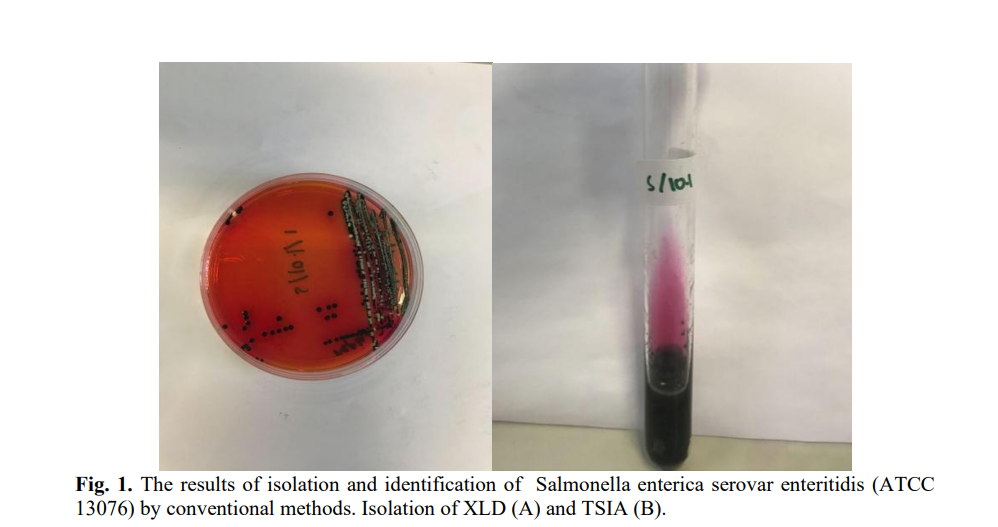
Salmonella enterica serovar enteritidis (ATCC 13076) isolates were cultured in Rappaport-Vassiliadis broth and incubated at 37°C for 24 hours. The culture was then streaked onto Xylose Lysine Deoxycholate (XLD) agar and incubated again at 37°C for 24 hours.
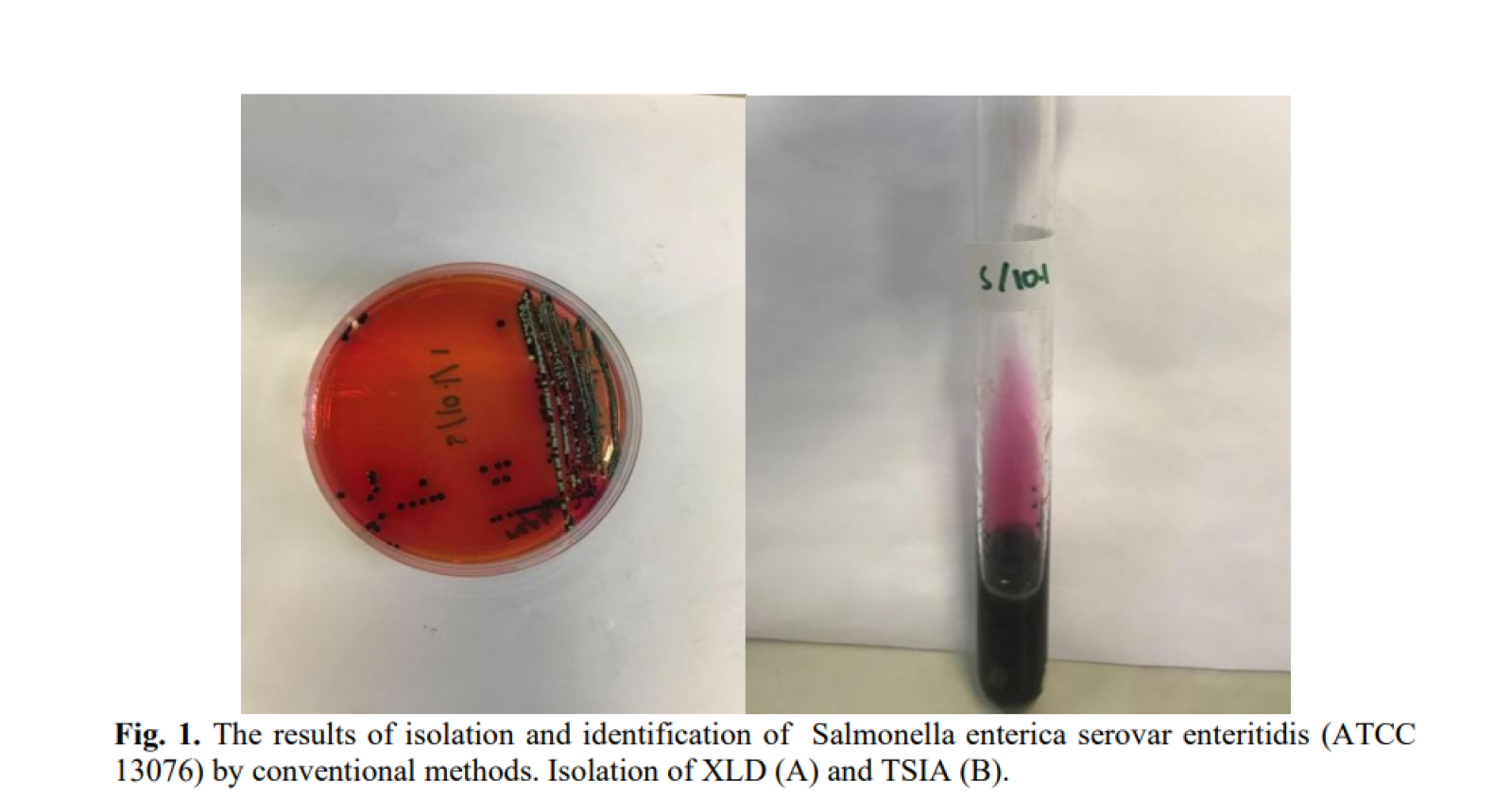
On XLD agar, Salmonella appears as round black colonies. These colonies were further confirmed using Triple Sugar Iron Agar (TSIA), showing a red alkaline slope, yellow acidic butt, gas production, and hydrogen sulfide (H₂S) formation.
Serial dilutions were prepared to obtain concentrations of 10¹, 10², and 10³ CFU/mL. A total of 360 samples were used to contaminate four food matrices: milk, chicken meat, egg albumin, and egg yolk. Each matrix consisted of 90 samples.
Samples were stored under refrigeration for 24 hours and analyzed using conventional methods. Data were analyzed descriptively.
4. Discussion
Salmonella is a major foodborne pathogen affecting both developed and developing countries. Contamination rates vary, with reports showing high prevalence in chicken meat and lower rates in milk and eggs.
Milk provides favorable conditions for bacterial growth due to its nutrients, neutral pH, and high water content. Poor hygiene practices can increase contamination risk.
Egg contamination can occur during formation or from environmental sources. Chicken meat is also a suitable medium for bacterial growth, especially at warm temperatures.
Environmental factors such as temperature, pH, and nutrient availability significantly influence Salmonella growth. Detection using H₂S production remains important, though some strains may not produce H₂S, indicating limitations of conventional methods.
The study highlights that detection efficiency varies by food matrix, with milk and egg albumin showing higher recovery rates compared to chicken meat.Salmonella enterica serovar enteritidis (ATCC 13076) showed black colonies on XLD media and typical TSIA reactions.
Re-isolation results showed:
- Milk: highest detection rate (up to 100%)
- Chicken meat: lower detection rate (36.7%–70%)
- Egg albumin and yolk: high detection (up to 96.7%)
Lower detection in chicken meat is likely due to competition with spoilage bacteria.